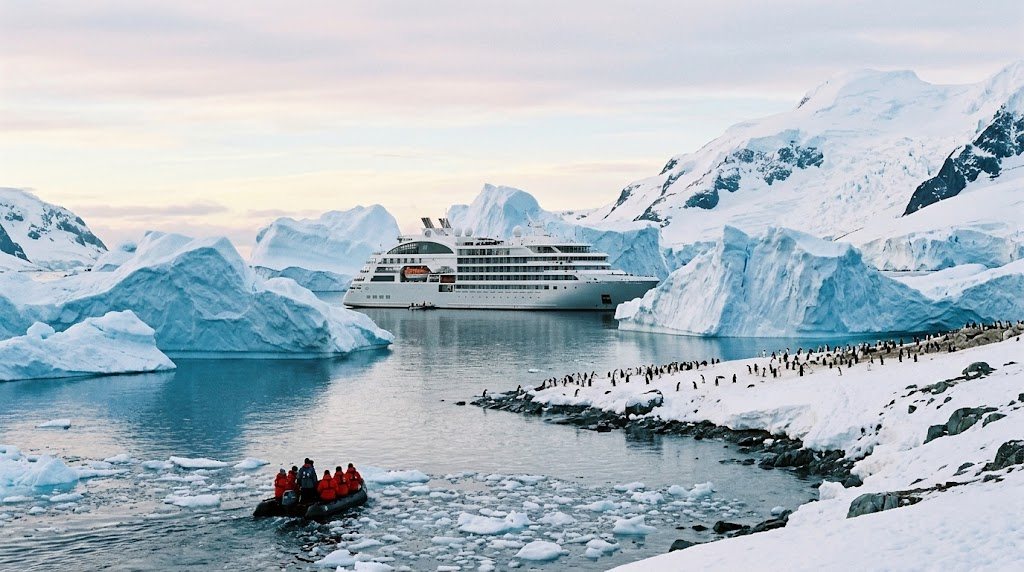
A new generation of polar ships pairs veranda suites and fine dining with Zodiacs, kayaks and even submarines. Here is where they sail and what makes each one special.
The polar regions were once the domain of scientists and hardy adventurers. Today they welcome travelers aboard elegant expedition ships with veranda suites, heated pools and teams of naturalists, while still delivering the raw wonder of ice, wildlife and silence.
A new generation of purpose-built ships has made this possible. Several have launched in the past few years, and another debuts this December. For travelers drawn to the ends of the earth, there has never been a more inviting moment to go.
A New Class of Polar Ship
Expedition cruising has quietly reinvented itself. The newest vessels pair strong ice-class hulls with the comforts of a fine small hotel, and they carry enough Zodiacs, kayaks and experts to put every guest close to the action each day.
What sets these ships apart:
- Ice-capable design, with polar class ratings that let them reach remote waters.
- Intimate scale, often between about 100 and 265 guests, so landings feel personal.
- Science on board, with labs and citizen science programs that invite guests to take part.
- Refined comfort, from veranda suites to spas, fine dining and observation lounges.
The Ships Leading the Way
Seabourn Venture and Seabourn Pursuit
Seabourn brought its ultra-luxury style to the polar regions with two purpose-built sister ships. Seabourn Venture was delivered in June 2022, and Seabourn Pursuit followed in July 2023, sailing her maiden voyage that August before heading south to South America and Antarctica.
Seabourn Pursuit carries up to 264 guests in 132 oceanfront veranda suites. The ship is built to PC6 Polar Class standards and supported by an expedition team of 24. Its toolkit for exploration is remarkable: a fleet of 24 Zodiacs, double sea kayaks and two custom-built six-person submarines for viewing life beneath the surface.
The combination of all-suite comfort and serious expedition capability has set a new reference point for luxury travel at the poles.
Le Commandant Charcot: Luxury at the Top of the World
Ponant's Le Commandant Charcot is one of the most ambitious passenger ships ever built. Delivered in 2021 by the Vard shipyard, it is built to Polar Class 2, the highest ice class for a purpose-built cruise ship, allowing it to operate in moderate multi-year ice.
It is also an innovation story. Le Commandant Charcot was the first electric hybrid cruise vessel with icebreaking capability, combining LNG, dual-fuel propulsion and high-capacity batteries. The ship carries 245 guests in 123 staterooms.
In September 2021, on one of its first voyages, it reached the geographic North Pole after setting out from Longyearbyen in Svalbard. For travelers dreaming of the High Arctic, it opens a horizon few have ever seen.
Douglas Mawson: Following the Great Explorers
Aurora Expeditions welcomed its newest ship, Douglas Mawson, in late November 2025, with a first voyage from Hobart, Tasmania, on November 27. Named for the celebrated Australian polar explorer, the ship carries up to 130 guests and includes a meaningful number of single-occupancy cabins, a welcome touch for solo travelers.
On board are two restaurants and bars, an outdoor heated pool with hot tubs, a wellness area, a lecture theater and a citizen science center. Its ULSTEIN X-BOW hull is designed for stability in heavy seas. Planned itineraries include an Antarctic expedition following Sir Ernest Shackleton's route, as well as voyages to the sub-Antarctic islands.
Magellan Discoverer: Fly to the Ice
For travelers with limited time, Antarctica21 offers a graceful shortcut. Its fly-cruise format begins in Punta Arenas, Chile, with a flight of about two hours to King George Island, where guests board ship and sail directly into the South Shetland Islands and the western Antarctic Peninsula. The flight replaces the two-way crossing of the Drake Passage.
Its new ship, Magellan Discoverer, welcomes its first guests on December 15, 2026. Built at the ASENAV shipyard in Chile, the hybrid-electric vessel is rated PC6 and is a sister to Magellan Explorer. It includes a dedicated science lab run with Chilean research institutions, and onboard sensors gather data on water temperature, salinity and air quality throughout the season.
A Day on an Expedition Ship
Life aboard follows the rhythm of weather, ice and wildlife rather than a fixed timetable, which is part of the magic. A typical day might unfold like this.
The morning begins with a wake-up call from the expedition leader announcing whales off the bow or a landing site free of ice. After breakfast, guests board Zodiacs for a shore landing among penguins or a slow cruise past glaciers. On ships that carry them, kayaks offer a quieter perspective, gliding at water level beside floating ice.
Afternoons bring a second outing or a lecture from the naturalists, historians and scientists on board. Citizen science programs invite guests to log seabird sightings, photograph whale flukes for identification or record cloud observations for researchers. Evenings close with a recap of the day, a fine dinner and, in the far south, the long light of the austral summer.
The best expedition teams make every guest feel like part of the voyage. Their knowledge turns a beautiful view into a story you understand.
Wildlife Moments to Hope For
No two voyages are alike, and nature sets the agenda. Still, certain encounters are high on every traveler's wish list:
- Penguin colonies in Antarctica, alive with sound and constant motion.
- Humpback whales feeding in the sheltered channels of the Antarctic Peninsula.
- Seals on the ice, from leopard seals to the sleepy Weddell seal.
- Polar bears and walruses in the Arctic, viewed respectfully from the water.
Antarctica or the Arctic?
Both regions are extraordinary, and they share the stage across the calendar:
- Antarctica (roughly November to March): penguin colonies, towering icebergs, whales and the sense of standing on another planet.
- The Arctic (the northern summer): Svalbard's glaciers, Greenland's fjords, polar bears and the midnight sun.
The two poles also feel different in spirit. Antarctica is a continent without a permanent human population, a place of pure wilderness and science stations. The Arctic is home to communities whose cultures are woven into the ice and sea, which adds village visits and local stories to the journey.
Many travelers begin with Antarctica for its sheer drama, then return north to the Arctic for its wildlife and culture. Either way, the newest ships make the journey as comfortable as it is unforgettable.
Choosing your polar voyage
The polar regions now welcome travelers in genuine style. Choose your ship by the experience you want most: submarines and all-suite luxury, a North Pole voyage, an explorer's itinerary or a fly-cruise that gets you to the ice faster.
Book early, especially for the newest ships and the most popular weeks of the season. Then pack your curiosity. Few journeys on earth leave a deeper impression than a quiet morning among the icebergs.
Sources
- Ship Technology, "Seabourn Pursuit Expedition Cruise Ship," accessed October 2026.
- Seatrade Cruise News, "Vard delivers Ponant's Le Commandant Charcot, world's first LNG/hybrid expedition cruise ship," August 2, 2021.
- Arctic Today (The Barents Observer), "A hybrid-electric luxury cruise ship has reached the North Pole for the first time," September 9, 2021.
- CruiseMapper, "Aurora Expeditions' ship Douglas Mawson enters service," November 24, 2025.
- Cruise Industry News, "Antarctica21 Kicks Off 2026-27 Season," October 2, 2026.
- TravelAge West, "New Cruise Ships for 2026," accessed October 2026.